 By Gonny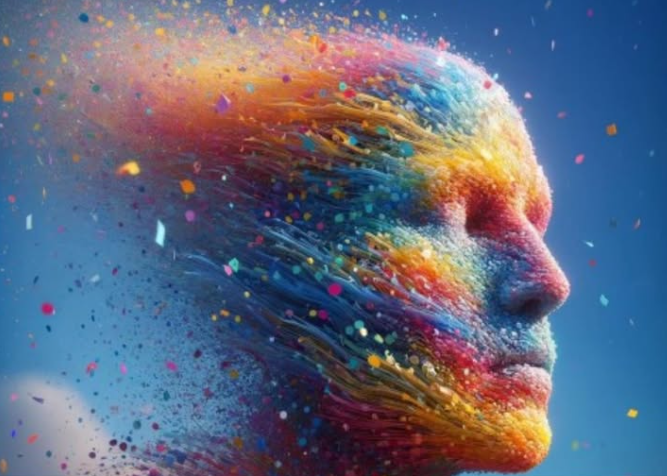
Have you ever been absolutely certain about something, only to discover it was never quite that way? Not a vague doubt, but a clear memory. A scene. A phrase. A detail you would almost swear on. And then… reality suddenly disagrees.
This is what people call the “Mandela Effect”. (The Mandela Effect is named after Nelson Mandela because many people clearly remember him dying in prison in the 1980s, even though he actually lived until 2013. This shared false memory led researchers to use his name to describe a phenomenon where large groups of people remember the same event differently from how it really happened.)
At first glance, it looks like a simple mistake of memory. The mind misfiles something, fills in a gap, borrows from something similar. Case closed.
But if we stay there, we might miss something quietly extraordinary. Because what if these little “errors” are not just mistakes… but invitations?
A small crack in certainty.
Imagine this m: You remember a song line one way. Millions of others remember it the same way. It feels familiar, shared, almost solid. And yet, when you check… it isn’t there.
Not just you. Not just one person…….many persons!!
Now pause for a moment. What is being shaken here is not the fact itself, but your trust in the stability of what you call reality.
And that is where it becomes interesting….because something in you begins to wonder: If even this is not as fixed as I thought… what else isn’t?
The mind does not record…it recreates
We often imagine memory as a kind of storage system, like a hard drive. But it isn’t.
The mind is creative. It reconstructs. It interprets. It fills in. It reshapes.
And A Course in Miracles goes even further. It tells us that the world itself is not something we passively observe, but something we actively make:
“I have invented the world I see.”
That is a radical idea. Not only are memories flexible… the entire perceptual field is.
So when a memory shifts, or appears inconsistent, it may not be a failure of the system…
It may be a glimpse of how the system actually works.
Parallel realities… or a flexible dream?
Some suggest that the Mandela Effect points to parallel realities. Different timelines. Slightly different versions of events. Overlapping layers of existence.
It’s a fascinating idea.
But even without going that far, there is something here worth seeing.
If the world is a kind of dream, as A Course in Miracles suggests, then small inconsistencies are not strange at all. Dreams are not perfectly consistent.
They feel real… until they don’t.
They shift. They blur. They rearrange themselves.
And yet, while you are in them, they feel convincing.
So perhaps the question is not: “Which version is correct?”
But rather: “What does this reveal about the nature of what I am experiencing?”
There is another layer here, a very human one.
When confronted with something like the Mandela Effect, the mind often reacts quickly: “I must be right.”
Or: “This must be explained.”
There is a subtle discomfort in not knowing, but A Course in Miracles invites a different approach. It gently loosens our grip on certainty: “You do not know the meaning of anything you perceive.”
Not as a criticism… but as freedom, because if you do not have to be right about the details…You are free to see more deeply.
Let’s bring this out of theory for a moment.
Imagine you notice a Mandela Effect that you strongly feel.
Instead of trying to prove your version…you pause.
And simply allow this thought: “Maybe what I see is not as fixed as I think.”
And then another:”If this is flexible…perhaps my interpretations are too.”
Suddenly, this is no longer about logos or movie lines. It becomes a doorway.
If perception is flexible…thenthe way you see:
– yourself – others – your past – your fears …may also be more open than you assumed.
And that changes everything.
There is no need to decide whether the Mandela Effect is caused by memory, timelines, or something we do not yet understand.
What matters is what it offers. A gentle loosening. A softening of rigid certainty.
A tiny opening in the belief that “this is the way it is, and cannot be otherwise.”
And through that opening…..something new can enter.
Not confusion. But space! (And maybe even a smile)
Because if reality is not as solid as we thought…then perhaps we are not as trapped as we sometime feel.
Perhaps the world is a little more like a shared dream..
And we are not just characters in it… But the ones quietly dreaming.
And occasionally…remembering.
With love and light,
G.