 By admin
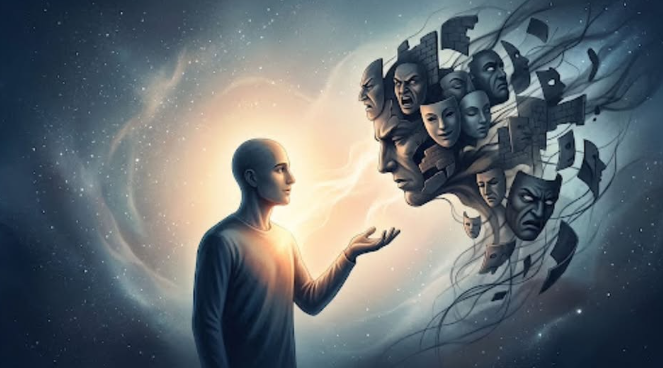
From the subtlest fear to the recognition of what we are…..
We often hear that we must overcome the ego, silence it, dissolve it, or even destroy it. Many spiritual teachings speak of freeing ourselves from the ego as though it were something living inside us, something standing between us and the peace we are searching for.
But I have always wondered: who is going to destroy the ego? Who is the one trying to overcome it? And isn’t that very desire to become free of the ego another expression of the ego itself?
For me, the essential word is not destruction. It is recognition.
To explain what I mean, I first need to explore what I understand the ego to be. Because I am not simply talking about pride, arrogance, selfishness, or the need to feel important. Those are only some of its more visible expressions.
To me, the ego is something far more fundamental.
The ego is the belief that I am a separate someone.
An individual who exists independently of everything else. Someone with a body, a personal history, thoughts, memories, desires, fears, and expectations. Someone who was born, moves through time, and will eventually die.
But where did this idea of being separate come from?
I begin with what I call Awareness, or simply Being. Not my personal awareness or yours, but the timeless, indivisible reality in which nothing is missing and nothing exists outside the Whole.
There is no opposite to this Being. No division, no comparison, no beginning or end. It simply is.
Now imagine the tiniest idea appearing: What if separation were possible? What if there could be something other than Oneness?
From that tiny idea of duality, an entire universe of apparent differences unfolds. A world of forms, space, time, beginnings and endings. A world in which there is an inside and an outside, a me and a you, something to gain and something to lose.
And with that apparent separation comes something that could never belong to absolute Oneness.
Fear.
Not merely the fear we experience when something frightening happens, but fear as the very foundation of the experience of separation.
Because the moment I believe I am a separate being, I also believe that something can happen to me. I can be hurt. I can lose what I love. I can become ill. I can be rejected, misunderstood, abandoned, or forgotten. I must protect myself, secure my future, and somehow make sure that I will be happy.
And so an entire world of thoughts, reactions, expectations, and behaviours develops around the protection of this imagined separate self.
We easily recognise fear when it appears as panic, anxiety, anger, jealousy, guilt, or grief. But what about its quieter expressions?
What happens when someone does not greet me and I wonder why? When someone disagrees with me and I feel a slight resistance? When I want to be appreciated, understood, respected, or thanked? When I am disappointed because another person does not behave as I expected?
What is being defended in those moments?
Perhaps nothing more than an image of myself. A belief about who I am and how the world should treat me.
And if I look even more closely, I begin to notice fear in increasingly subtle movements. A little doubt. A need for reassurance. A barely noticeable discomfort. The wish to control an outcome. The hope that tomorrow will be better than today.
Even the desire to become a more spiritual, peaceful, or enlightened person may contain a hidden assumption: that something is missing from what I am now.
This is why I see fear as having countless layers, from the most overwhelming to the almost invisible.
And this is also why I believe recognition is so essential.
When I notice anger, I do not need to condemn myself for being angry. When I discover jealousy, insecurity, or a desire for recognition, I do not need to fight it. I can simply become curious.
What am I believing right now? What am I trying to protect? What do I think I might lose? Why does my peace seem to depend on what someone else says or does?
And beneath those questions lies an even deeper one.
Who is this ‘me’ that feels threatened?
The moment I recognise the belief behind a reaction, something begins to change. Not because I have forced the reaction to disappear, but because I no longer need to believe its story so completely.
Recognition is not suppression. It is not denial, and it is certainly not another reason to judge ourselves.
It is simply seeing more clearly.
And as I continue to look, I discover that the ego can be remarkably subtle. It can even turn spirituality into another form of self-protection.
I may begin to feel proud of how peaceful I have become. I may compare my spiritual understanding with that of others. I may become frustrated because I still experience fear. I may even decide that I must destroy my ego once and for all.
But who is making that decision?
Isn’t it once again the imagined separate self, trying to accomplish something that will finally make it complete?
The ego can turn even its own destruction into a personal achievement.
And that brings me back to my original question. Why try to destroy something that, according to A Course in Miracles, has never been real in the first place?
A belief does not need to be killed. It needs to be recognised for what it is.
But this recognition takes us further than our emotions and everyday reactions. It eventually brings us to something we almost never question.
The body.
What is the body?
A form.
It appears, changes, ages, and eventually disappears. No body remains unchanged forever. Everything that exists as form is subject to change, and everything that changes can be lost.
Now, impermanence itself is not an emotion. But when I believe that I am something impermanent, the possibility of fear is built into that identification.
If I believe I am the body, then my existence appears vulnerable. My life seems to depend on something that cannot last.
And this raises a fundamental question.
Can what I truly am be something that is destined to disappear?
A Course in Miracles describes the world of separation as a dream. Not because we do not experience it, but because, within its metaphysical teaching, separation from Oneness has never actually occurred.
If Love is the only reality, fear cannot be an equally real foundation. If Oneness is truly One, there cannot be a second reality outside it.
Fear may be the foundation of the world as the ego perceives it, but it cannot be the foundation of Being itself.
And that is precisely why the Course speaks of a dream.
In an ordinary dream, we can experience danger, loss, happiness, suffering, and even death. Everything seems real while we are dreaming. Yet upon awakening, we realise that the events of the dream never happened in the way we believed they did.
What if our experience of being a separate individual is similar?
What if the problem is not that we are living in a reality filled with fear, but that we believe in a separation that never truly happened?
Then awakening would not mean transforming a fearful individual into a perfectly loving one.
It would mean recognising that the separate individual was never our true identity.
And naturally, another question arises.
Does the dream end when the body dies?
But death itself belongs to the world of forms. We observe other bodies dying, and we imagine our own future death. We may experience the process of dying, but we cannot experience our own completed non-existence as an event and then look back upon it.
The body, its birth, its life, and its death all belong to the story of separation.
If awakening means recognising what is beyond that story, then death cannot be the cause of awakening. Otherwise, we would still be giving something within the dream the power to free us from it.
This is where another deeply rooted belief comes into view.
Time.
We are so accustomed to time that we rarely question it. We believe we are travelling from yesterday through today towards tomorrow. We carry our memories, our personal histories, our hopes, and our fears about the future.
But where do we actually experience any of this?
Here. Now.
My childhood appears as a memory now. My plans for tomorrow appear as thoughts now. Even my belief that I have spent many years searching for spiritual understanding is something I am experiencing in this present moment.
I never directly experience yesterday or tomorrow. I experience remembering and anticipating, now.
And if time itself belongs to the dream of separation, then the idea that I will finally awaken at some future moment is also part of that dream.
This changes the meaning of spiritual practice entirely.
I do not have to wait until I am more advanced. I do not have to overcome all my major fears before recognising the smaller ones. I do not have to become a better version of myself.
Every moment in which fear appears is an opportunity to recognise the belief behind it.
Every irritation, expectation, disappointment, desire, or subtle resistance offers the same possibility.
Not to move one step closer to what I truly am, but to recognise that I have never actually moved away from it.
Of course, even the phrase every moment still belongs to our experience of time. But as long as time seems to exist, each moment can serve as an invitation to look again.
And eventually, recognition itself becomes even more subtle.
At first, I recognise the obvious forms of fear. Then the smaller ones. Then the almost invisible movements of the separate self. And finally, I begin to question the one who claims to be doing all this recognising.
Who is the observer?
Who is the one saying, ‘I am not the body’?
Who is the one trying to awaken?
As long as there is an individual who believes it must reach a state of enlightenment, there may still be a subtle division between what I am and what I believe I should become.
Even the observer can be part of the dream.
And perhaps the deepest recognition is not, ‘I have finally overcome all my fears.’
Perhaps it is:
There was never a separate ‘me’ that could truly be threatened.
At this point, I want to make an important distinction concerning the word consciousness.
In English, we often encounter two words that may be translated similarly in other languages: consciousness and awareness. Yet in non-dual discussions they can point towards different understandings.
In A Course in Miracles, particularly in T-3.IV.2, consciousness is described as the level of perception, associated with the apparent separation. There is a perceiver and something perceived. There is already duality.
But when I speak of Awareness as the origin, I mean what non-dual language often calls pure awareness. Not an individual who is conscious of something, but timeless Being, without a separate observer or an object that needs to be observed.
This distinction is not a universal definition of the two English words. Nor does the Course consistently use awareness as a technical term for absolute reality. The Course itself more explicitly distinguishes between knowledge and perception.
Perhaps, therefore, Being or Oneness is the clearer word for what I am trying to express.
And this brings me to the words with which I would like to end.
I Am.
Not ‘I am this body.’ Not ‘I am my personality.’ Not ‘I am my memories, beliefs, experiences, or achievements.’
And not even ‘I am the observer who has finally understood the truth.’
Because that would still suggest a separate someone who has reached a conclusion.
When I say I Am, I am pointing towards Being itself, without adding anything to it. No separate identity, no description, no boundary, no beginning or end.
And of course, even I Am, Being, and Awareness are still words. They can only point towards what cannot ultimately be contained in language.
Perhaps this is why I no longer feel drawn to the idea of destroying the ego.
What would I be destroying?
An imagined identity? A belief in separation? A collection of thoughts that I have mistaken for myself?
I do not need to fight them. I do not need to become someone better, higher, or more spiritual.
I only need to recognise what I have been believing, from the most obvious fear to the most subtle identification, until even the belief in a separate recogniser is seen through.
And what remains is not a perfected ego.
It is not a higher self that has defeated a lower self.
It is what has never been absent.
Love, without an opposite. Being, without a boundary. Eternity, without time.
Not something I must become.
Not something I will finally discover after death.
Not something waiting for me at the end of a long spiritual journey.
Simply what I have always been.
And perhaps, when even those words are no longer needed, there is nothing left to explain.
Only Being.
With love and light,
G